Jane Rochford
Wolf HallJane Rochford is a courtier in Anne Boleyn’s circle whose watchfulness and candour turn household access into political intelligence. She moves between public court life and private conversation: observing the Boleyn family’s crisis, speaking frankly with Thomas Cromwell, and interpreting the pressures surrounding Anne’s marriage and the royal succession. Her own childlessness and anxiety about her marriage complicate her role as an observer of other people’s intimate and dynastic affairs.
Identity and Court Position
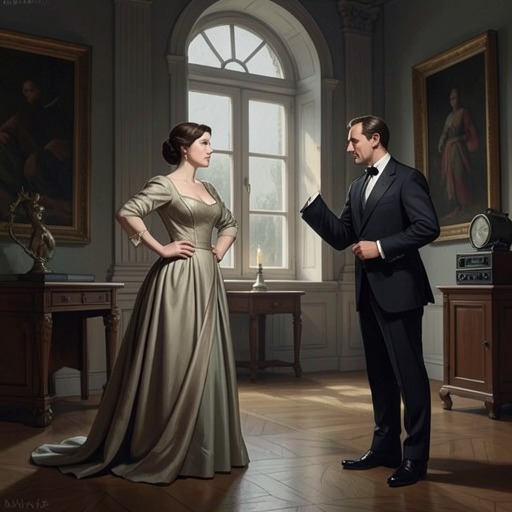
Jane appears among Anne’s attendants and family associates, alongside Mary Shelton and Mary Boleyn. In private gatherings she can speak for the women around Anne, announce when Mary Boleyn is about to confer with Cromwell, and tease Anne about her former attachment to Harry Percy. That familiarity gives her access to the queen’s domestic circle, but it does not make her merely a companion: she notices who is excluded, who is useful, and what information might matter beyond the chamber.
Her courtly manner combines bluntness with a capacity to provoke. When she advises packing Anne’s bags and sending her to Kent after the king demands an inquiry into the alleged precontract with Harry Percy, she makes the danger explicit: Percy may testify, and the king cannot simply overlook a concealed marriage. The suggestion is politically severe, and George Boleyn threatens her for making it; Jane nevertheless presents it as honest counsel. Her willingness to speak when the family is under pressure establishes her as a participant in its deliberations, not just a witness to them.
Anne Boleyn’s Circle and the Percy Crisis
Jane is present when Anne’s household confronts the consequences of Percy’s marriage difficulties. Anne is enraged by the prospect that Percy’s wife may petition Parliament for a divorce on the grounds that the marriage was never valid because Percy had been promised to Anne. In the ensuing meeting, Jane urges that Anne be sent away before the king’s anger worsens the crisis. The room’s other responses range from George’s threat to strike her to Thomas Boleyn’s attempt to formulate a cautious approach; Jane’s intervention cuts through that hesitation by naming the danger of an inquiry and unimpeded testimony.
In a later conversation with Cromwell, Jane again treats courtship and marriage as matters with political consequences. She tells him that Harry Percy has gone mad and is spending his money, while Anne reflects that she would at least have occupied the honourable position of a wife had the earlier match gone ahead. Jane’s remarks place her within the circle that can revisit the thwarted match as both personal history and political risk. The passage does not establish the truth of all the court’s reports about Percy; it shows how those reports circulate among Anne’s companions and shape their understanding of her predicament.
Information, Friendship, and Suspicion
Jane approaches Cromwell with an offer of friendship and a claim to useful knowledge. She tells him that Mary Boleyn is no longer wanted at court now that Anne has resumed her duties in the bedchamber, and asks what he will do if the queen has no further child. Her question turns personal allegiance into a question of succession: Anne’s place and Cromwell’s position depend, in Jane’s view, on a future that cannot be taken for granted.
Jane also challenges the familiar assumptions that make women bear the blame for reproductive failure. She observes that men claim credit for sons, blame wives for daughters, and attribute childlessness to a woman’s womb rather than a man’s fertility. Her argument is direct, and it connects the court’s succession crisis to a broader imbalance in how responsibility is assigned. She speaks from a household where Anne’s pregnancies are matters of state, but also from her own experience: she has been married for seven years without a child and says, lightly, that she believes her husband wishes her dead.
Her disclosures about Anne are a mixture of observation, inference, and insinuation. Jane asks whether Cromwell imagines that Anne has given up the verses and attentions of young men, and describes the queen as outwardly pious while questioning whether that appearance tells the whole story. She also speculates about the private relationship between Anne and Henry, their capacity to produce an heir, and the possibility that their desire has faded. These remarks are Jane’s claims, not independently confirmed facts. Their narrative force lies in how they expose the scrutiny directed at the royal bed and the uncertainty beneath the court’s public display of marital confidence.
Marriage, Fear, and Personal Vulnerability
Jane’s intelligence is inseparable from her own vulnerability. She tells Cromwell that she has no child after seven years of marriage and fears her husband and his sister, who spend time together in private. She asks that, if she dies, her body be examined because she is afraid of poison. The request is evidence of her fear, not proof that anyone has poisoned her or intends to do so. Her account reveals how suspicion can become part of life at court, where private relationships and succession politics are continually interpreted for danger.
She also tells Cromwell that Anne has boasted of poisoning Mary Tudor, and suggests that Anne might harm even her own sister if it suited her. These are grave allegations made by Jane, not established events. Cromwell listens but questions what Jane herself understands and how far her suspicions can be trusted. Their exchange therefore leaves her in a deliberately unsettled position: she may be perceptive about concealed motives, but the scene also shows that her fears and interpretations cannot simply be treated as verified knowledge.
Jane understands that Cromwell is guarded about his own attachments. She tells him she knows where he has placed his heart and suggests that the Seymours might be willing to arrange a marriage with Jane Seymour. Cromwell denies that this is the nature of his interest, describing his involvement with young gentlemen and wards as part of his marriage business. Jane mocks the denial and accuses him of lying to the Commons as well as to her. The encounter makes her a reader of other people’s evasions, while showing that her own offer of friendship comes with an expectation that she will be heard.
Narrative Role and Significance
Across these episodes, Jane functions as an informal intelligence-gatherer whose access is personal rather than official. She can speak in Anne’s rooms, report shifts in who is wanted at court, identify a possible succession problem, and bring private suspicions to Cromwell. That knowledge does not amount to control: she cannot settle Anne’s future, ensure a royal heir, or protect herself from the uncertainties she describes. Her position illustrates how political information travels through household relationships as well as through councils and formal offices.
Jane’s scenes also put the royal succession under intimate scrutiny. Public claims about Anne’s queenship and the expected birth of a son coexist with conversations about Percy’s disputed marriage, Anne’s fertility, the king’s sexual and emotional life, and women’s exposure to blame. Jane makes these tensions speakable, sometimes insightfully and sometimes speculatively. The narrative neither confirms her allegations nor reduces her to a reliable source; instead, it presents her as a socially alert but personally anxious courtier whose sharp observations reveal the pressure surrounding the women on whom dynastic politics depends.